Home » Norovirus in 2026: Trends, Risks, and Public Health Prevention
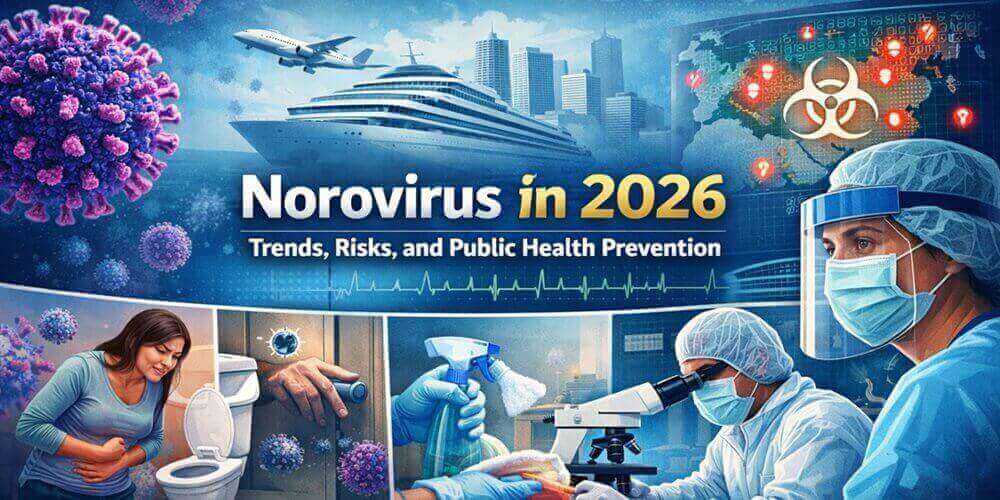
Norovirus remains one of the most contagious viral infections worldwide, responsible for millions of cases of acute gastroenteritis each year. Commonly referred to as the stomach flu norovirus, this virus continues to challenge public health systems in 2026 due to its rapid transmission, environmental resilience, and seasonal outbreak patterns.
With increasing urbanization, global travel, and high-density communal living, understanding what is norovirus, how it spreads, and how to prevent infection has never been more important.
This content covers everything you need to know about norovirus infection in 2026, including symptoms, causes, treatment options, outbreak trends, recovery process, and prevention strategies.
Norovirus is a highly contagious virus that causes acute inflammation of the stomach and intestines (gastroenteritis). It spreads rapidly because it requires only a small number of viral particles to infect a person.
Unlike influenza, which affects the respiratory system, norovirus attacks the digestive tract.
Because of these characteristics, norovirus outbreaks can escalate quickly in schools, cruise ships, hospitals, restaurants, and nursing homes.
Norovirus is a highly contagious virus that causes inflammation of the stomach and intestines, a condition known as acute gastroenteritis. It affects people of all ages and spreads rapidly in close-contact environments.
Unlike influenza, norovirus does not affect the respiratory system. Instead, it targets the digestive tract.
Key characteristics of norovirus:
Norovirus outbreaks are common in schools, cruise ships, hospitals, nursing homes, and restaurants.

The clinical presentation of norovirus symptoms has remained consistent over time, although improved reporting systems in 2026 allow earlier detection of outbreaks.
Symptoms typically begin 12–48 hours after exposure and may include:
Most cases resolve within 1–3 days. However, dehydration remains the most significant complication.
Young children, older adults, and immunocompromised individuals are at greater risk of severe complications.
Understanding norovirus causes helps reduce infection risk.
Norovirus infection occurs when viral particles enter the body through the mouth, typically via:
Even microscopic contamination can lead to infection.
Food handlers who work while symptomatic are a common source of outbreaks.
Norovirus transmission is rapid because the virus spreads through multiple routes simultaneously.
Main transmission pathways include:
In crowded settings such as cruise ships or care facilities, a single infected individual can trigger widespread transmission within days.
A person can remain contagious for up to two weeks after recovery.
Several factors influence norovirus outbreak patterns in 2026:
While norovirus traditionally peaks in winter months, unpredictable climate shifts have extended outbreak seasons in some regions.
Global mobility increases cross-border spread of viral strains.
Advanced genomic sequencing now helps identify emerging strains more quickly.
Hospitals and long-term care facilities remain high-risk environments due to close-contact settings.
Public health agencies have improved real-time outbreak reporting systems, allowing earlier containment measures.
The phrase stomach flu norovirus is widely used but medically inaccurate.
Norovirus is not related to influenza.
Influenza:
Norovirus:
The confusion arises because both illnesses may involve fever and fatigue.
There is currently no specific antiviral medication for norovirus treatment.
Treatment focuses on supportive care.
How Is Norovirus Treated?
Antibiotics are ineffective against viral infections.
Hospital care may be required for severe dehydration, especially in vulnerable populations.
Research continues into vaccine development, but no widely available vaccine exists as of 2026.

Most healthy individuals recover within 1–3 days.
However:
This extended shedding period contributes to ongoing transmission risk.
Preventing norovirus infection requires strict hygiene and environmental control measures.
What Are the Most Effective Prevention Methods?
Alcohol-based hand sanitizers are less effective against norovirus compared to proper handwashing.
Public health authorities now focus on:
Enhanced surveillance tools allow early intervention and outbreak containment.
Although anyone can contract norovirus, high-risk groups include:
Extra precautions are essential for these populations.
If symptoms develop:
Returning to work or school too soon increases outbreak risk.
In 2026, norovirus remains highly contagious but better understood.
Advancements in:
are reducing large-scale outbreaks.
However, prevention still depends heavily on individual hygiene compliance.
The term stomach flu norovirus can be misleading.
Norovirus is not related to influenza. Influenza affects the respiratory system, while norovirus affects the gastrointestinal tract.
The confusion arises because both conditions can cause:
However, norovirus primarily causes vomiting and diarrhea
Norovirus is a highly contagious virus causing vomiting and diarrhea due to gastrointestinal inflammation.
Through contaminated food, surfaces, person-to-person contact, and aerosolized particles.
Up to two weeks after symptoms resolve.
No specific cure; treatment focuses on hydration and symptom management.
Rarely, but severe dehydration can be dangerous in vulnerable populations.
In 2026, public health agencies emphasize:
Although norovirus remains highly contagious, improved awareness and hygiene compliance significantly reduce risk.
Despite advances in public health monitoring, norovirus remains a global concern due to its resilience and contagious nature.
In 2026, norovirus remains one of the most persistent and rapidly spreading viral infections worldwide, making public awareness more critical than ever. Although advances in outbreak surveillance, genomic monitoring, and infection-control protocols have improved response times, the virus’s extreme contagiousness and environmental durability continue to pose significant challenges. Because norovirus spreads easily through contaminated food, surfaces, and close contact—and because individuals can remain contagious even after symptoms subside—prevention depends heavily on informed personal behavior. Understanding what norovirus is, recognizing early norovirus symptoms, and applying strict hygiene practices such as proper handwashing and surface disinfection are essential to limiting transmission.
Ultimately, while healthcare systems can implement protective measures, reducing the impact of norovirus outbreaks in 2026 still relies on individual responsibility, timely action, and widespread public health education.
In 2026, prevention through hygiene, awareness, and early response remains our strongest defense.